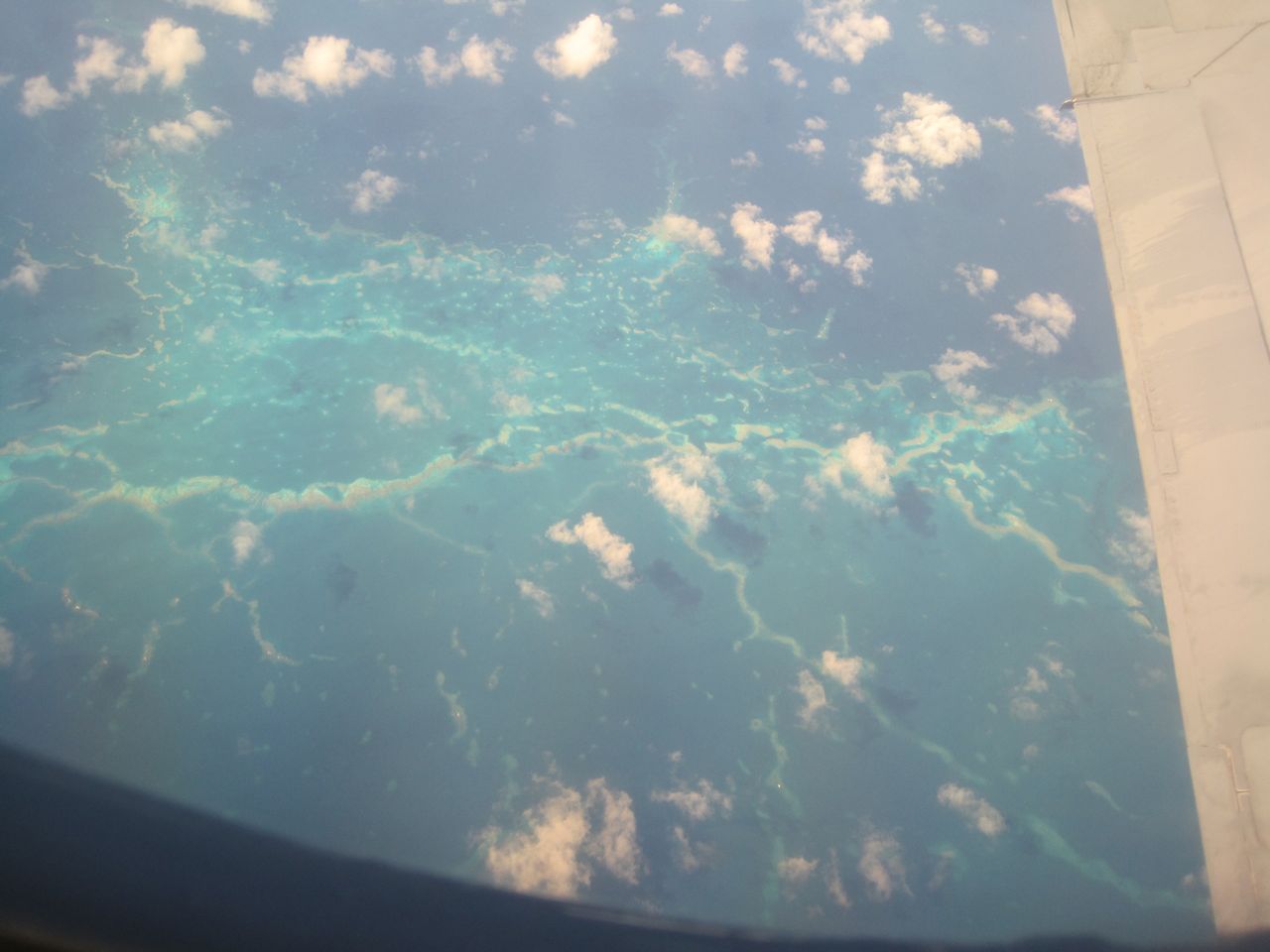
satellite view from PMNM
E komo mai; welcome! Midway Atoll National Wildlife Refuge is surrounded by a lei of foam in the middle of the North Pacific; it's a beautiful, special place.

Not only are there albatross on Midway, but many other interesting kinds of wildlife, both on the land and in the sea. Please enjoy exploring FOAM, an educational blog actively done while on Midway from May through August 2010. Posts are added from off-Midway, as information becomes available. If you're interested in a particular topic, please use the search box or the alphabetical list of "labels" along the left side of the blog page.

Tuesday, November 16, 2010

Laysan Albatross Return to Midway Atoll: You Are There

Laysan Albatross Photo Gallery; James Lloyd, 2007
What a difference a month makes!  Have a look at this ~30-second video that Joanna recorded on October 17.  See any albatross?  Nope, because there aren't any on the entire Atoll.  There's no audio to this video, but if there were, you probably would hear only the breeze and maybe some White Tern "rubber-band" calls, since these birds live on the Atoll year around.
Midway Atoll, October 17, 2010 from Barb Mayer on Vimeo.

Now watch Joanna's video from a windy day on Sunday, November 14.  Can you see that there are now albatross present?  And she says only a little more than half of them are back; more are arriving every day!  In the video, you can hear the wind...and albatross whistles.
Midway Atoll, November 14, 2010 from Barb Mayer on Vimeo.
 _______________________________________________________________________________ 
December 2010 update:
Here's the newest video by Joanna; LOOK AT ALL THE LAYSAN ALBATROSS!!!  Pretty amazing, huh?!  And do you hear them?!  Albies: welcome back to Midway, your largest nesting colony in the world!

Midway Atoll, December 14, 2010, from Barb Mayer on Vimeo.

Sunday, November 14, 2010

Golden Gooney seen on Midway Atoll!

Short-tailed Albatross Gallery; James Lloyd, 2007
I'm no longer on Midway, but my friend Joanna is.  She's one of two volunteers now on the Atoll, and she's experiencing the return of thousands of albatross.  It's getting quite noisy!

Wow; she spotted the very rare Short-tailed Albatross (STAL) on Sand Island!!  The photo to the left shows an adult bird.  With that golden head, you can certainly understand why it's also called the Golden Gooney.

Below is a video of the STAL taken by Joanna.  The caption says the video is mine, but she's the videographer, not me. We're just storing the video on my Vimeo account.

Enjoy Joanna's video!  You'll notice the bird doesn't have the same golden head and neck as shown in the photograph to the left.  That's because the bird that James photographed back in 2007 is an adult, and Joanna's bird is younger, not fully adult yet.  However, it's still a big bird; notice how much bigger it is than the Black-footed Albatross, with which it doesn't seem to get along--


Short-tailed Albatross from Barb Mayer on Vimeo.

Monday, August 30, 2010

Final Post -- Aloha, Midway Atoll!


Midway Atoll's Eastern Is. and the emergent reef "lei"
It's the end of August, and my time on Midway has come to an end.  I'm now back home in Waimānalo on the island of O`ahu.  I had a WONDERFUL three months on the Atoll, and my sincere thanks go to the US Fish and Wildlife Service for allowing me to serve as a volunteer.  I had an opportunity to help with many different kinds of wildlife management projects, and I learned a lot.

So, this is my last post, at least for the foreseeable future.  I'd love to volunteer again, especially at a different time of year, to be able to see the albatross, Laysan Ducks, and other wildlife at a different season in their life cycles.  If I do get another volunteer opportunity, I'll certainly re-open FOAM; I've enjoyed creating it very much!

Aloha nui loa, Midway...a hui hou?!
Barb
a few pictures taken from the plane as we flew back to Honolulu--

Pearl and Hermes Atoll

Laysan Atoll
Maro Reef

Goooooooo! Laysan Albatross Takeoff!

Imagine you're a Laysan Albatross chick. 

I know it's hard, but try.  You started life inside an egg.  Sure, a Laysan Albatross egg is bigger than the egg in your refrigerator.  But it's still an egg, and you're crammed in there for 2 months.

Then you hatch out of the egg; whew!  But the view doesn't get much better because you're so close to the ground, you can see the sky only when you look straight up.  And that's only when a parent isn't sitting over you.

About 5 months after hatching, you "fledge," meaning you lose the last of your downy feathers and you grow flight feathers.  Now you're ready for a long life spent mostly flying over the ocean!

But right now you're on the ground.  You've never, ever flown before.  How do you do it?  Well, first of all, you practice, like the albatross in the picture above.  Stretch out your wings, and get the hang of it, as shown in this practice video--

Laysan Albatross PREPARE to Fly from Barb Mayer on Vimeo.
Once you get the hang of it, you'll take off on this "albatross runway," like these adult birds.  Off you goooooooooo!

Albatross Runway, Midway from Robert OToole on Vimeo.

Thursday, August 26, 2010

Quack Patrol

photo by Cari
Come along with the Quack Patrol!

In the hot summer months the Quack Patrol conducts almost daily checks of every wetland on Sand Island for deadly bird botulism.  If we find a dead duck, we'll collect it carefully and put it in a ziploc bag with information about where and when we found it.  Then we put the bag in a freezer until a veterinarian can examine it to find out if botulism poison really did kill the duck. 

If we find a sick bird -- good news! -- we wrap it in clean towels and take it into the US Fish and Wildlife Service lab, where the duck is cared for.  You can read more about the care of botulism-sick ducks in the July 3 post "Laysan Ducks: Battling Botulism."

As you can see in the picture, I and my bicycle are loaded down with equipment.  My binoculars, with sunglasses hooked on, are strapped across me.  In my pocket is a pencil...and even a second one, in case I lose the first one.  I'll stuff the clipboard with its data table into the bike basket. The net (for scooping dead ducks out of the water) will be stuck through the basket's handle.  My metal water bottle is already in the bike basket, along with my backpack.  The pack contains clean towels for sick birds...and ziploc bags for dead birds, which I hope we don't find!  

We're ready to ride to the first wetland, called Ball Field Big; let's go!  After seeing the 5-minute video, perhaps you'd like to check out any of these 3 FOAM Activity Pages:  


Bike Ride to Laysan Ducks from Barb Mayer on Vimeo.

Tuesday, August 24, 2010

Marine Debris INSIDE Albatross

Here's a post by me: Auntie Moana Laal--

Adult albatross ready to feed its chick
Have you ever had a really bad stomach ache?

Have you ever had something stuck in your throat?

Imagine having both at once, and maybe you'll have an idea of what it's like for our albatross chicks to get too much marine debris in their stomachs!

It's pretty awful!  You can read about it in a reader's theater script about me "saving the day."  I won't spoil the ending by telling you how I saved the day, but I'm sure glad I did.  My nephew Kawika, Jr. almost died from too much plastic in his stomach!

Laysan Albatross carcass filled with plastic marine debris.
You see, albatross chicks are accidentally fed plastic by their parents, who have accidentally picked up plastic marine debris that's floating on the ocean.  I've made the mistake myself.  Sometimes a floating cigarette lighter looks like squid, and I eat the lighter.  Another time maybe one of my favorite foods, flying fish eggs, are stuck to a floating plastic bottle cap, and I swallow both.  Then, if I don't know I've made a mistake, I accidentally pass the plastic to my chick during feeding.  Auwe!

Let me tell you about a sad but important video made by my friend Paulo Maurin.   His 5-minute video "306 Punches" is about a Laysan Albatross chick on Kure Atoll that probably did die from swallowing too much plastic.  As you watch the video you see Cynthia Vanderlip, the Field Station Manager of Kure, performing an autopsy on the chick...and then you see how much plastic was inside that albatross!

Like I said, we saved my nephew Kawika.  The good news is that most albatross chicks don't die; they grow up to become adults, like me.  We can live for more than half a century, flying for hours over the beautiful ocean...but we need help.  Learn how you can help by visiting my cousin Makana, at the Monterey Bay Aquarium.
Aloha; mahalo for your concern!

Sunday, August 22, 2010

Rubber Band Birds

When they are on Midway, the peculiar whistling and clacking albatross calls are the loudest bird sounds of anybody.  Sounds from the Red-tailed Tropicbirds are also loud and squawk-y.  But what does Midway sound like when the albatross and Tropicbirds have flown away?

White Terns are year-around Atoll residents.  Don't you think they make a sound like the twanging of a rubber band?!


Rubber Band Birds from Barb Mayer on Vimeo.