

Showing posts with label albatross. Show all posts
Showing posts with label albatross. Show all posts
Tuesday, January 21, 2014
Take a "Virtual Visit" to Midway


Saturday, January 14, 2012
Albatross is TWO STORIES tall!
You don't believe me? Well take a look at this --
During his visit to Midway Atoll NWR, Wyland painted a mural on Charlie Barracks (near L7 on the map.). The video clip above is a time lapse taken during the painting project. Can you see the Hawaiian Green Sea Turtle hovering over some limu, or seaweed, as well as a graceful Hawaiian Monk Seal? And there they are, a pair of huge dancing Laysan Albatross. If they were real, I wonder how loud their song would be ?!
(photos: Wyland Earle Midway Atoll 2011)
During his visit to Midway Atoll NWR, Wyland painted a mural on Charlie Barracks (near L7 on the map.). The video clip above is a time lapse taken during the painting project. Can you see the Hawaiian Green Sea Turtle hovering over some limu, or seaweed, as well as a graceful Hawaiian Monk Seal? And there they are, a pair of huge dancing Laysan Albatross. If they were real, I wonder how loud their song would be ?!
(photos: Wyland Earle Midway Atoll 2011)
Tuesday, March 22, 2011
The resilience of life: post-tsunami reflections
 |
| area not impacted by tsunami photo by Anna Liem |
We're all relieved to hear the USFWS announcement that Wisdom has returned safely to her nest after the tsunami, and was seen feeding her chick. Although the parents of the STAL chick on Eastern have not yet been sighted, USFWS is hopeful that they are still at sea gathering food and, like Wisdom, will eventually return.
Wisdom's return serves as a reminder that, while this year's cohort of chicks was undoubtedly severely impacted by the tsunami and the two heavy winter storms this year, there are still hundreds of thousands of breeding adults who survived and will continue to return to Midway and raise new chicks for years to come.
 |
| USFWS volunteer Ipo rescuing a waterlogged bird photo by Anna Liem |
But the numbers are only part of the story. Yes, the 300 birds we rescued are a tiny percentage of the birds impacted by the tsunami and the storms, but each of those birds is an individual, just like Wisdom, whom we managed to save. Perhaps we didn't make a huge difference to the albatross population, but we made a huge difference to those individual birds.
All those involved in the rescue efforts walked away with wounds on our hearts from seeing all the birds we couldn't save, but what we will strive to remember instead are the wounds on our arms from the bites of the frightened birds that we did save. I can hardly express the comfort I took and the satisfaction I felt in lifting a newly-freed chick, still covered in wood chips, from the debris and carrying it to safety. As I remember that feeling, it reminds me that, in the face of disaster, both the best and the least we can do is to try to save as many as we can.
Saturday, March 19, 2011
Update on Midway Atoll's Tsunami
 |
| The tsunami washed over the red-shaded areas; USFWS graphic. |
- "...more than 110,000 Laysan and black-footed albatross chicks – about 22 percent of this year’s albatross production..." have been lost this year as a result of winter storms followed by the tsunami
- "At least 2000 adults were also killed."
- "Wisdom, the 60-year-old albatross that recently hatched a chick, was initially reported as surviving the event because her nest site was not overwashed, but biologists have not been able to confirm her survival."
- Only 4 albatross chicks have been found on the Atoll's smallest island, Spit. Before the winter storms and tsunami, there had been 1520 albatross nests.
- Although the Short-tailed Albatross has survived all winter storms and the tsunami, the "chick's parents...have not been seen since the tsunami. Since the chick is incapable of fending for itself, the Service will carefully consider whether hand-rearing this bird is appropriate if it is determined that it is not being fed by its parents."
There's nothing we can do to prevent tsunamis and other natural disasters. Even with loss of many individual birds, albatross species have survived these events before, and we expect them to survive this one, too.
But what we can do is work to prevent human disasters on wildlife. For example, we can be more careful about keeping plastic out of the ocean, so that albatross don't die from swallowing it by mistake. Fishing boats can catch fish with gear that doesn't accidentally catch albatross.
Let's try harder to protect albatross and our Planet Earth!
Sunday, March 13, 2011
How Big were Midway's Tsunami Waves?
 |
| from NOAA: Height of the seawater at Midway's Sand Island during the March 10-11, 2011 tsunami. |
Y axis is height of the seawater. GMT = Greenwich Mean Time
MLLW = "the average of the lowest tide recorded at a tide station each day during the recording period," according to Wikipedia
WL = water level (I think!) __________________________________________________________________________
 |
| Midway Harbor dock; photo by Pete Leary |
11:36 p.m. -- 1.5 feet
11:48 p.m. -- 4.9 feet
12:18 p.m. -- 4.3 feet
12:48 p.m. -- 2.2 feet
One or more of these waves washed completely over the smallest island of the Atoll, called Spit. Over half of Eastern Island, where the World War II battle took place, was swamped.
All the people live on the Atoll's third island, Sand Island, 20% of which was covered by the tsunami waves. Everyone was safe; before the first wave was predicted to hit Midway, they all evacuated to the top floor of Charlie Barracks. In the days after the tsunami, there does not seem to be much damage to Midway.
Midway's birds are not doing as well. As Anna noted in her blog entry just below, the good news is that the Short-tailed Albatross chick has survived! This is the second time it's been washed out of its nest cup!
About the Laysan Albatross, John Klavitter, the Acting Refuge Manager, says the death toll for adults and subadults is probably a "minimum of 1000," and "tens of thousands of Laysan Albatross chicks [were] lost." Since the Black-footed Albatross generally live closer to the ocean, they may have an even higher death toll. Pete at Midway's blog has pictures of albatross and other birds tangled in mud and bushes. I think some of the pictures are sad. But some other pictures show hard-working staff, volunteers and visitors rescuing birds...and even a lucky honu (green sea turtle)!
additional information: "Hawaii's Laysan and Black-footed Albatrosses have likely suffered heavy losses in last week's tsunami," by Dr. Lindsay Young
Friday, March 11, 2011
Tsunami Hits Midway
Guest blogger Anna here with news about the aftereffects of the tsunami on Midway Atoll.
The earthquake off the coast of Japan generated a tsunami that hit Midway around 11:40 pm last night. The tsunami was about 5 feet high, and flooded some parts of the island. Sadly, at least some chicks and adult LAALs were killed, and dozens if not hundreds of chicks were washed away from their nests onto roadways and under bushes. Fortunately the nests inland were not affected, and both the adult LAALs and their chicks are going about their business as usual. The chicks are fuzzy balls of fluff right now, and should be ready to fly in a few weeks.
Update:
Volunteers and visitors to the island spent the afternoon freeing dozens of albatross chicks who had been washed into and caught inside thickets of naupaka. This often required hacking through the bushes with large clippers and small saws, and either crawling through the spaces or climbing on top of the branches to perch suspended over the ground. Visitors also dug out many petrels who had been trapped and buried in their burrows.
While Eastern Island was hard hit, amazingly the short-tailed albatross chick survived!
 |
| albatross chicks caught in Naupaka bush; photo by Pete Leary. |
 |
| Short-tailed Albatross chick on Midway's Eastern Island; photo by Pete Leary. |
Volunteers and visitors to the island spent the afternoon freeing dozens of albatross chicks who had been washed into and caught inside thickets of naupaka. This often required hacking through the bushes with large clippers and small saws, and either crawling through the spaces or climbing on top of the branches to perch suspended over the ground. Visitors also dug out many petrels who had been trapped and buried in their burrows.
While Eastern Island was hard hit, amazingly the short-tailed albatross chick survived!
Wednesday, March 9, 2011
An Albatross Named Wisdom
 |
| Wisdom with her chick; photo by John Klavitter |
Go to the titles at the top of this page. Click on the one called "Midway Map." See the green box with L10 in it? That's where I live, near the Fish and Wildlife Office...when I'm not flying over the North Pacific Ocean. But my friend Wisdom, she lives near L7. These are the neighborhoods for Laysan Albatross. The green boxes with letter B are for the Black-footed Albatross. 'Course we LAALs are all over Midway Atoll, but these green boxes are the only places where the scientists come every week to see how our chicks are doing. It's called measuring our "reproductive success."
Talk about reproductive success! Wisdom wins da prize! She's 60 years old!...and she's still laying eggs and hatching out babies! Check out da picture; cute chick, yeah? Wisdom is da oldest LAAL on the island...at least from all the Laysan albies that have been banded. Most little chirpy song birds live only a year or two. No wonder she's called Wisdom, living for 60 years. Wisdom's reproductive success has made the news; check out "Oldest known wild bird returns to Midway Atoll to raise chick." She's famous!
My brother's sister-in-law's uncle told me about an albatross down in New Zealand called Grandma. She lived to be 60 years old before she disappeared, so we think she's gone from this world. We never met her, though, cuz we don't fly down there...and Grandma never flew up here.
Anyway, just thought I'd let you know that we're celebrating here on Midway -- congratulations, Wisdom; maika`i!
Sunday, March 6, 2011
Short-tailed Albatross Chick is NOT Blown Away
 |
| Short-tailed Albatross chick; photo by John Klavitter |
What happened to the one-and-only STAL chick on Midway?
As Ellen reported, "Staff and volunteers checked the STAL nest the next afternoon and observed the male on the nest.... After several minutes of searching, the chick was found about 25-m away, apparently washed out of the nest cup by the surf. Fortunately, the chick appeared to be in good health and was returned back to the nest cup by refuge staff. The adult male initially moved a few feet from the nest when the chick was placed in the cup, but returned to the nest about 45 minutes later."
As of February 23, the chick seemed fine. At that time it was about about "50% larger than the largest Black-footed albatross chicks."
As soon as I hear more, updated information, I'll write another post. Let's hope the good news continues!
Thursday, February 10, 2011
Short-tailed Albatross Chick Eating Well
Sometimes albatross will hānai, or adopt, another bird's egg. Hhhhhmmmm, maybe the Short-tailed Albatross adults on Midway's Eastern Island had been incubating a Laysan Albatross egg instead of one of their own? Maybe the chick that hatched from the egg on January 14 is really a Laysan Albatross?
Careful scientists at the US Fish and Wildlife Service wanted to be sure their young bird was really a STAL. So, the bird scientists (ornithologists) sent pictures of the baby bird to experts at the Yamashina Institute of Ornithology in Japan. Result -->; the Japanese experts said, "Hai! Yes!"...the young chick really does look like a Short-tailed Albatross! In the video below you'll notice the chick has a very chunky bill, which is a STAL characteristic.
Also, the baby STAL should grow faster than chicks of other kinds of albatross, like Black-footed Albatross. The video shows the heads of a pair of BFAL adults in the front...but that's a STAL decoy, or model, on the right.
Also, the baby STAL should grow faster than chicks of other kinds of albatross, like Black-footed Albatross. The video shows the heads of a pair of BFAL adults in the front...but that's a STAL decoy, or model, on the right.
The STAL chick is almost a month old, and it seems to be doing well. How would you like your dad to feed you this way?! Yum!--
video by Pete Leary, Midway Atoll NWR Biologist
Monday, January 17, 2011
Happy Hatch Day, Baby Short-tailed Albatross!
 |
| photo of male STAL and chick by Pete Leary, 1-17-11 |
Sing along with the US Marine Corps band as it performs the Happy Birthday song:
Happy hatch day to you!
Happy hatch day to you!
Happy hatch day baby STAL!
Happy hatch day to you!
>>Hana hou (= repeat; sing it again)!For more information, see:
Friday, December 10, 2010
Short-tailed Albatross Nest on Midway for the First Time!
 | |
| photo of female STAL on nest by USFWS volunteer Sarah Gutowsky, Midway, 12/1/10 |
As acting Refuge Manager John Klavitter writes, "On Nov. 16, refuge staff observed an adult short-tailed albatross incubating a freshly laid egg on Eastern Island...." [Look at the aerial view of Midway Atoll at the top of this page; Eastern is the triangle-shaped island on the southeast side of the Atoll.] "Since then, the refuge staff members have observed the male and female trading off incubation duties."
During modern history, Short-tailed Albatross (STAL) have been found only in territory belonging to Japan; their main nesting grounds are on Torishima Island. In fact, Midway's "Mr. and Mrs. STAL,"(if we can call them that!) were hatched on the Japanese island; Mr. in 1987, and the younger Mrs. just seven years ago in 2003. But it's a good thing these adult birds have come to nest on Midway. As the picture below shows, their home island is an active volcano! (On the map, Midway Atoll is one of the small dots in the Hawaiian Island chain; it's probably a dot near the right-hand edge of the photo.)
 |
| map, by Hiroshi Hasegawa, located on the Wake Forest University Albatross Project website |
Isn't it wonderful that this pair of Short-tailed Albatross has chosen to nest on Midway, where there's no volcano? Wouldn't it be terrific if their egg hatches, and they return in the future to lay more eggs? And wouldn't it be REALLY GREAT if this pair were joined by more STAL and they establish a colony in the Refuge?!
Tuesday, November 16, 2010
Laysan Albatross Return to Midway Atoll: You Are There
 |
| Laysan Albatross Photo Gallery; James Lloyd, 2007 |
Midway Atoll, October 17, 2010 from Barb Mayer on Vimeo.
Now watch Joanna's video from a windy day on Sunday, November 14. Can you see that there are now albatross present? And she says only a little more than half of them are back; more are arriving every day! In the video, you can hear the wind...and albatross whistles.
Midway Atoll, November 14, 2010 from Barb Mayer on Vimeo.
_______________________________________________________________________________
December 2010 update:
Here's the newest video by Joanna; LOOK AT ALL THE LAYSAN ALBATROSS!!! Pretty amazing, huh?! And do you hear them?! Albies: welcome back to Midway, your largest nesting colony in the world!
Midway Atoll, December 14, 2010, from Barb Mayer on Vimeo.
Sunday, November 14, 2010
Golden Gooney seen on Midway Atoll!
 |
| Short-tailed Albatross Gallery; James Lloyd, 2007 |
Wow; she spotted the very rare Short-tailed Albatross (STAL) on Sand Island!! The photo to the left shows an adult bird. With that golden head, you can certainly understand why it's also called the Golden Gooney.
Below is a video of the STAL taken by Joanna. The caption says the video is mine, but she's the videographer, not me. We're just storing the video on my Vimeo account.
Enjoy Joanna's video! You'll notice the bird doesn't have the same golden head and neck as shown in the photograph to the left. That's because the bird that James photographed back in 2007 is an adult, and Joanna's bird is younger, not fully adult yet. However, it's still a big bird; notice how much bigger it is than the Black-footed Albatross, with which it doesn't seem to get along--
Short-tailed Albatross from Barb Mayer on Vimeo.
Monday, August 30, 2010
Goooooooo! Laysan Albatross Takeoff!

Imagine you're a Laysan Albatross chick.
I know it's hard, but try. You started life inside an egg. Sure, a Laysan Albatross egg is bigger than the egg in your refrigerator. But it's still an egg, and you're crammed in there for 2 months.
Then you hatch out of the egg; whew! But the view doesn't get much better because you're so close to the ground, you can see the sky only when you look straight up. And that's only when a parent isn't sitting over you.
About 5 months after hatching, you "fledge," meaning you lose the last of your downy feathers and you grow flight feathers. Now you're ready for a long life spent mostly flying over the ocean!
But right now you're on the ground. You've never, ever flown before. How do you do it? Well, first of all, you practice, like the albatross in the picture above. Stretch out your wings, and get the hang of it, as shown in this practice video--
Laysan Albatross PREPARE to Fly from Barb Mayer on Vimeo.
Once you get the hang of it, you'll take off on this "albatross runway," like these adult birds. Off you goooooooooo!
Albatross Runway, Midway from Robert OToole on Vimeo.
Tuesday, August 24, 2010
Marine Debris INSIDE Albatross
Here's a post by me: Auntie Moana Laal--
 |
| Adult albatross ready to feed its chick |
Have you ever had something stuck in your throat?
Imagine having both at once, and maybe you'll have an idea of what it's like for our albatross chicks to get too much marine debris in their stomachs!
It's pretty awful! You can read about it in a reader's theater script about me "saving the day." I won't spoil the ending by telling you how I saved the day, but I'm sure glad I did. My nephew Kawika, Jr. almost died from too much plastic in his stomach!
 |
| Laysan Albatross carcass filled with plastic marine debris. |
Let me tell you about a sad but important video made by my friend Paulo Maurin. His 5-minute video "306 Punches" is about a Laysan Albatross chick on Kure Atoll that probably did die from swallowing too much plastic. As you watch the video you see Cynthia Vanderlip, the Field Station Manager of Kure, performing an autopsy on the chick...and then you see how much plastic was inside that albatross!
Like I said, we saved my nephew Kawika. The good news is that most albatross chicks don't die; they grow up to become adults, like me. We can live for more than half a century, flying for hours over the beautiful ocean...but we need help. Learn how you can help by visiting my cousin Makana, at the Monterey Bay Aquarium.
Aloha; mahalo for your concern!
Thursday, August 19, 2010
A Curious Way of Walking

I know that Barb had quite a few FOAM posts about our cousins, the Laysan Albatross (LAAL)...but not quite as many about us, the Black-footed Albatross (BFAL.) At the moment I'm not on Midway; I'm enjoying the open-ocean life in the North Pacific. BBC Arkive's short video showing BFAL flight will give you an idea of what I think it feels like to soar over the sea: wonderful!
We BFALs return to Midway earlier than the LAAL, but that won't be until sometime in November. Then I'll find Clarissa, we'll mate, and she'll lay our 2011 egg!

Black-footed Albatross from Barb Mayer on Vimeo.
Monday, August 9, 2010
Albatross Have Big Feet
 |
| Barb's foot alongside bones from an albatross foot |
 |
| albatross footprints |
 |
| live albatross feet |
Albatross Feet Underwater from Barb Mayer on Vimeo.
Monday, August 2, 2010
Satellite Tag Backpack for a Laysan Albatross


FOAM's July 23 post was entitled "The Albatross are Gone!...but Where?" We learned that satellite tags attached to Laysan Albatross sent information about where they were. A map showed us the locations of 2 birds in April 2009.
Naturally, I was really excited when John Klavitter, Manager and Biologist of Midway Atoll National Wildlife Refuge, asked if I'd like to see satellite tags attached to a few of this year's albatross fledglings (chicks)!!


Can you spot the satellite tag on the albatross in the picture below?! No? --that's because John and Greg did such a good job! I'll bet all you can see, if you look closely, is the transmitter's antenna. This bird is all set; it's ready to fly away from Midway Atoll! As it flies, the satellite tag will transmit information about where it is. And the battery is good for a whole year!

Thursday, July 29, 2010
Feather Phenomenon

So I went to investigate. Yep; there they were: I could see many feathers sticking out of the sand all along the beach. You can see three in front of this Laysan Albatross.
Over the years I've seen lots of feathers along many beaches, but they've always been lying down flat on the sand. I've never seen even one feather stuck point down into the beach...unless someone did it on purpose.
Katie and Thea said they didn't do it; so who did?

 |
| crabs browsing the tide line |
And then a whole handful of feathers floated in. They were all attached to a rotting piece of Laysan Albatross skin, I think. The crabs seemed to get closer and closer to the feather mass. Finally, one hopped onto the feathers and began eating; yum!


Have a look at the 8 feathers in these pictures. I pulled the 4 top feathers out of the beach; the bottom 4 came from the mass of feathers that had washed ashore. Is it my imagination, or do the beach feathers looked "chewed up," both the feather edges and the pointed quill ends?
I think crabs are pulling feathers into their holes just like we bring take-out food to our homes!
Tuesday, July 27, 2010
A Crab's Job

 On Sunday, July 25th I posted "Some Albatross Don't Make It." Remember I said I was going to dig up the dead Laysan Albatross and see if the crabs had eaten some of it? The picture on the left shows the tools, a dust broom and a shoe brush, that I used to uncover the dead albatross, which had been left on the beach since July 3.
 The picture on the right shows what the buried albatross looked like, and the picture below...
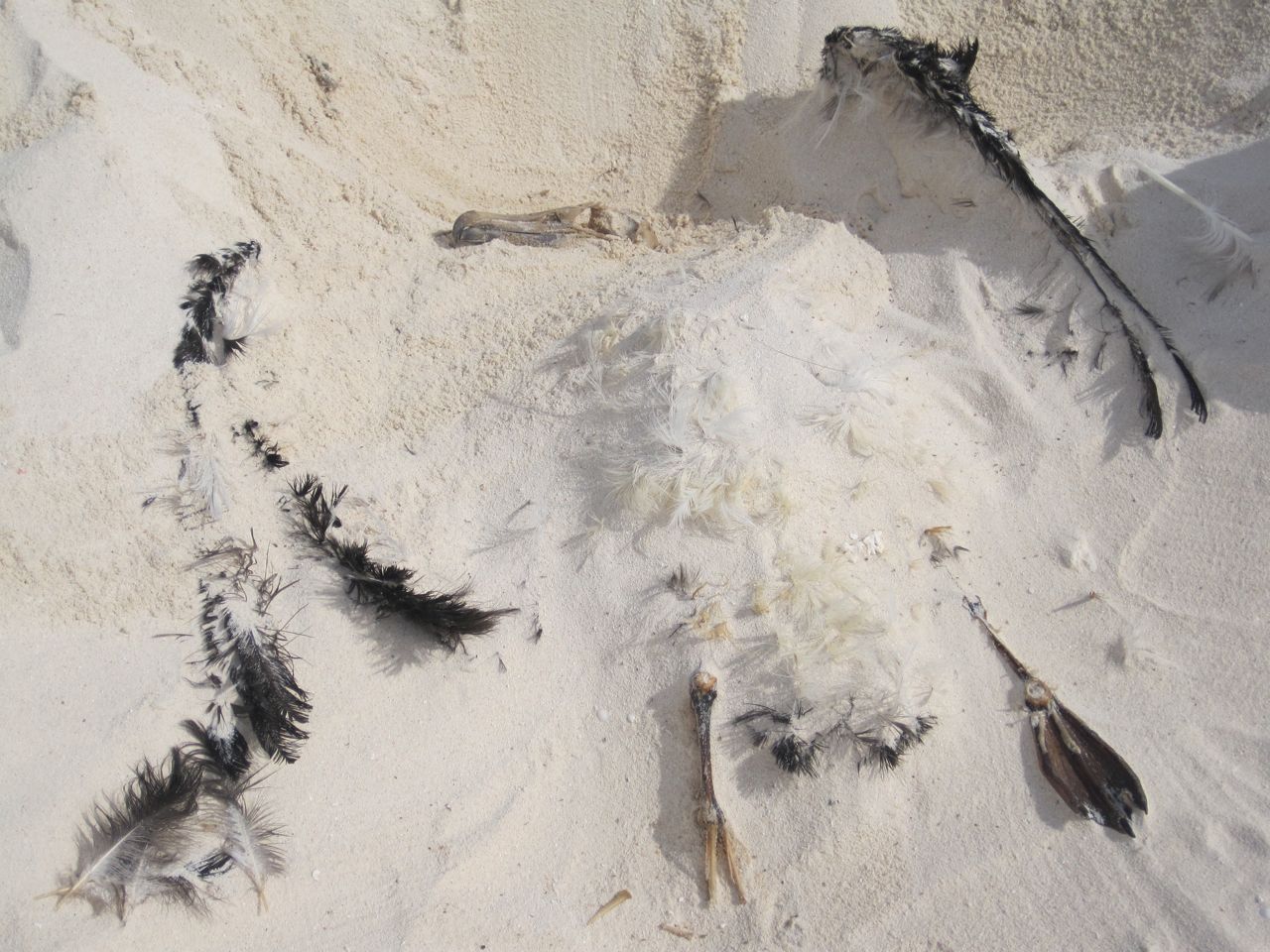
...is a little deeper view. It looks to me as if the beach crabs have for sure been eating the body. The skull looks especially cleaned. The web is gone from the right foot, but the left one is still in place.
So, beach crabs have a job to do: they are scavengers and keep beaches clear of dead albatross and other animals. Good job, crabs! Keep working!
Subscribe to:
Posts (Atom)

