satellite view from PMNM
E komo mai; welcome! Midway Atoll National Wildlife Refuge is surrounded by a lei of foam in the middle of the North Pacific; it's a beautiful, special place.

Not only are there albatross on Midway, but many other interesting kinds of wildlife, both on the land and in the sea. Please enjoy exploring FOAM, an educational blog actively done while on Midway from May through August 2010. Posts are added from off-Midway, as information becomes available. If you're interested in a particular topic, please use the search box or the alphabetical list of "labels" along the left side of the blog page.

Showing posts with label mōlī. Show all posts

Monday, August 30, 2010

Goooooooo! Laysan Albatross Takeoff!

Imagine you're a Laysan Albatross chick. 

I know it's hard, but try.  You started life inside an egg.  Sure, a Laysan Albatross egg is bigger than the egg in your refrigerator.  But it's still an egg, and you're crammed in there for 2 months.

Then you hatch out of the egg; whew!  But the view doesn't get much better because you're so close to the ground, you can see the sky only when you look straight up.  And that's only when a parent isn't sitting over you.

About 5 months after hatching, you "fledge," meaning you lose the last of your downy feathers and you grow flight feathers.  Now you're ready for a long life spent mostly flying over the ocean!

But right now you're on the ground.  You've never, ever flown before.  How do you do it?  Well, first of all, you practice, like the albatross in the picture above.  Stretch out your wings, and get the hang of it, as shown in this practice video--

Laysan Albatross PREPARE to Fly from Barb Mayer on Vimeo.
Once you get the hang of it, you'll take off on this "albatross runway," like these adult birds.  Off you goooooooooo!

Albatross Runway, Midway from Robert OToole on Vimeo.

Tuesday, August 24, 2010

Marine Debris INSIDE Albatross

Here's a post by me: Auntie Moana Laal--

Adult albatross ready to feed its chick
Have you ever had a really bad stomach ache?

Have you ever had something stuck in your throat?

Imagine having both at once, and maybe you'll have an idea of what it's like for our albatross chicks to get too much marine debris in their stomachs!

It's pretty awful!  You can read about it in a reader's theater script about me "saving the day."  I won't spoil the ending by telling you how I saved the day, but I'm sure glad I did.  My nephew Kawika, Jr. almost died from too much plastic in his stomach!

Laysan Albatross carcass filled with plastic marine debris.
You see, albatross chicks are accidentally fed plastic by their parents, who have accidentally picked up plastic marine debris that's floating on the ocean.  I've made the mistake myself.  Sometimes a floating cigarette lighter looks like squid, and I eat the lighter.  Another time maybe one of my favorite foods, flying fish eggs, are stuck to a floating plastic bottle cap, and I swallow both.  Then, if I don't know I've made a mistake, I accidentally pass the plastic to my chick during feeding.  Auwe!

Let me tell you about a sad but important video made by my friend Paulo Maurin.   His 5-minute video "306 Punches" is about a Laysan Albatross chick on Kure Atoll that probably did die from swallowing too much plastic.  As you watch the video you see Cynthia Vanderlip, the Field Station Manager of Kure, performing an autopsy on the chick...and then you see how much plastic was inside that albatross!

Like I said, we saved my nephew Kawika.  The good news is that most albatross chicks don't die; they grow up to become adults, like me.  We can live for more than half a century, flying for hours over the beautiful ocean...but we need help.  Learn how you can help by visiting my cousin Makana, at the Monterey Bay Aquarium.
Aloha; mahalo for your concern!

Thursday, August 19, 2010

A Curious Way of Walking

Here's a post by me, Edward Bfal.--

I know that Barb had quite a few FOAM posts about our cousins, the Laysan Albatross (LAAL)...but not quite as many about us, the Black-footed Albatross (BFAL.)  At the moment I'm not on Midway; I'm enjoying the open-ocean life in the North Pacific.  BBC Arkive's short video showing BFAL flight will give you an idea of what I think it feels like to soar over the sea: wonderful!

We BFALs return to Midway earlier than the LAAL, but that won't be until sometime in November.  Then I'll find Clarissa, we'll mate, and she'll lay our 2011 egg!

But I do have some photos from this summer at our Sand Island B8 neighborhood to share with you FOAM folks.  Above is a rather nice picture of me sitting in the native plant pōhuehue (beach morning glory, Ipomoea pes-caprae.)  Here's a larger picture of one of my nephews that makes me laugh, with his wild "haircut."  And I think you might enjoy this short video showing the rather curious way we BFALs walk.


Black-footed Albatross from Barb Mayer on Vimeo.

Monday, August 9, 2010

Albatross Have Big Feet

Barb's foot alongside bones from an albatross foot
Yes, albatross do have big feet.  For comparison, my foot is a size 8.  What size shoe do you think a Laysan Albatross would wear?

albatross footprints
live albatross feet
See what albatross feet can do in this half-minute movie--


Albatross Feet Underwater from Barb Mayer on Vimeo.

Monday, August 2, 2010

Satellite Tag Backpack for a Laysan Albatross


FOAM's July 23 post was entitled "The Albatross are Gone!...but Where?"  We learned that satellite tags attached to Laysan Albatross sent information about where they were.  A map showed us the locations of 2 birds in April 2009.

Naturally, I was really excited when John Klavitter, Manager and Biologist of Midway Atoll National Wildlife Refuge, asked if I'd like to see satellite tags attached to a few of this year's albatross fledglings (chicks)!!

In the lefthand picture above I'm holding a transmitter so you can see the entire thing.  It's like a small backpack with thin straps.  The closeup picture shows what the actual satellite tag, or transmitter, looks like.  You can't really see it in detail because it's all wrapped up in black electrical tape for protection.  It's small, about the size of a pack of gum.  The USFWS doesn't use anything that weighs more than 3% of what an albatross weighs.  In both pictures you can see the antenna, which is about 8" long.

John (on the left) and Biological Technician Greg Schubert (right) look for just the right "candidate" fledgling.  They look for a healthy, full-size albatross.  When they find it, they work together quickly and carefully to put the satellite tag backpack on the bird.  It's sort of like helping someone put on a jacket.  They make sure the transmitter fits snugly against the bird's body and the straps go between rows of feathers.  Looks like a good fit!

Can you spot the satellite tag on the albatross in the picture below?!  No? --that's because John and Greg did such a good job!  I'll bet all you can see, if you look closely, is the transmitter's antenna.  This bird is all set; it's ready to fly away from Midway Atoll!  As it flies, the satellite tag will transmit information about where it is.  And the battery is good for a whole year!

Thursday, July 29, 2010

Feather Phenomenon

My friends Katie and Thea told me about the feather phenomenon.

So I went to investigate.  Yep; there they were: I could see many feathers sticking out of the sand all along the beach.  You can see three in front of this Laysan Albatross.

Over the years I've seen lots of feathers along many beaches, but they've always been lying down flat on the sand.  I've never seen even one feather stuck point down into the beach...unless someone did it on purpose.

Katie and Thea said they didn't do it; so who did?


My friends sat on the beach...quietly...for awhile...very patiently...until they saw...a crab take a feather, point first, down into its hole!  Ah haaaaa!  That's it!  The crabs are sticking the feathers into the beach!  But why?  Do crabs like to decorate their neighborhoods?

crabs browsing the tide line
I thought maybe the crabs were eating the feathers.  I decided to spend some time sitting on the beach and observe very patiently, just like Katie and Thea.  And I did notice crabs hanging around feathers.  But it seemed to me that the crabs weren't eating feathers; they seemed to be eating tiny scraps of food from the tide line on the beach.

And then a whole handful of feathers floated in.  They were all attached to a rotting piece of Laysan Albatross skin, I think.  The crabs seemed to get closer and closer to the feather mass.  Finally, one hopped onto the feathers and began eating; yum!


Have a look at the 8 feathers in these pictures.  I pulled the 4 top feathers out of the beach; the bottom 4 came from the mass of feathers that had washed ashore.  Is it my imagination, or do the beach feathers looked "chewed up," both the feather edges and the pointed quill ends?

I think crabs are pulling feathers into their holes just like we bring take-out food to our homes!

Tuesday, July 27, 2010

A Crab's Job

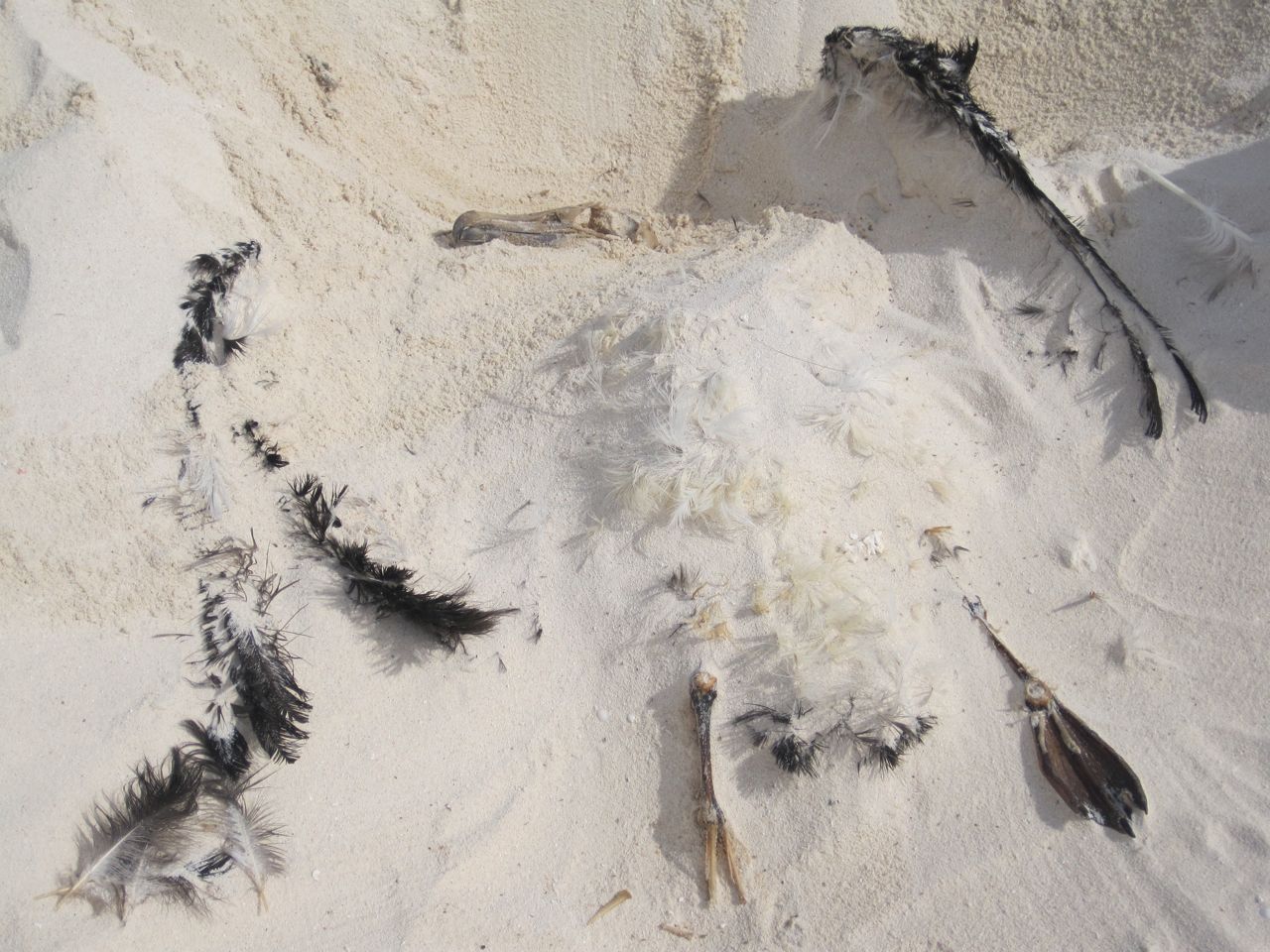
On Sunday, July 25th I posted "Some Albatross Don't Make It."  Remember I said I was going to dig up the dead Laysan Albatross and see if the crabs had eaten some of it?  The picture on the left shows the tools, a dust broom and a shoe brush, that I used to uncover the dead albatross, which had been left on the beach since July 3. 
The picture on the right shows what the buried albatross looked like, and the picture below...  

...is a little deeper view.  It looks to me as if the beach crabs have for sure been eating the body.  The skull looks especially cleaned.  The web is gone from the right foot, but the left one is still in place.  

So, beach crabs have a job to do: they are scavengers and keep beaches clear of dead albatross and other animals.  Good job, crabs!  Keep working!

Sunday, July 25, 2010

Some Albatross Don't Make It

The last FOAM post reported that Laysan Albatross chicks fledge (grow up) on Midway Atoll and then fly away, over the North Pacific Ocean. 

And that's a nice image: adult black-and-white Laysan Albatross soaring over the deep blue ocean, gazing off into the distance with their shadowed eyes....

But some albatross don't make it.  Some don't get beyond the Atoll's lagoon; they die and wash up on shore.

I began to wonder what becomes of these dead albatross.  I noticed the bodies seemed to disappear into the sand.  So I set up an observation activity for myself.  On July 3 I took the albatross from the shoreline that's pictured above and placed it up the beach, far from the waves.  Then I marked the area with 4 objects that you see in the picture on the left.  Starting top left and going clockwise, the objects are:
---small, blue float
---large, round, black float
---plastic water bottle
---broken float wrapped with rope mesh
And then I took a picture every few days.  Here are the pictures in time order:
July 7
July 6


July 9
July 8


July 12
July 11


July 18
July 15
July 20
Notice all the crab holes in the right-hand column, 3rd picture down, the July 12th snapshot.  I think the beach crabs have been eating the albatross, and as the body gets smaller and smaller, it takes up less space, and sinks into the sand!  Today is July 24th.  I'm going to dig up the area and see what's left.  Maybe I'll find albatross bones and feathers that have been cleaned by crabs?!  Stay tuned for the next post.

Friday, July 23, 2010

The Albatross are Gone!...but Where?


[On July 28 corrections were made to this post.]
How many Laysan Albatross (LAAL) do you see in this left-hand picture?  Maybe only 5?  Wow, there used to be LOTS in this field...so many that you really couldn't count them!  
The photo on the right shows the same field 2 months ago.  This snapshot appeared in the FOAM post on May 31, "What's Different?"  See!!  There were LOTS of albatross.  Most of them in the field at that time were Laysan Albatross chicks at the black, downy-feathered stage.  Now that it's the end of July, the chicks have grown up and have flown away from Midway Atoll National Wildlife Refuge, their place of birth, or rather "hatch."  Where have all the albatross gone?--where have they flown to?
On a number of posts, I've said that albatross fly off to the North Pacific.  But the North Pacific Ocean is a big place.  US Fish and Wildlife Service scientists asked the question, "Where exactly, in the North Pacific do Midway Atoll albatross go?"

To answer the question, last year scientists chose 4 Laysan Albatross that had hatched on the Atoll.  On July 13, 2009 each albatross was fitted with a small, solar-powered satellite tag.  When these albatross flew away from Midway, tags transmitted the location of each albatross twice each day.  Scientists were able to map that data, or information.  


Here's a map of the North Pacific Ocean from April 4, 2010.  Hawai`i is the string of islands near the center at the bottom of the map, and Midway Atoll is the 2nd island from the left.  Tiny gray circles show where albatross were on different days, and connecting red lines show the flight path.  (I don't know why over half the map is gray.  Perhaps that part of Earth is having night?)

The map has locations for only 2 of the original 4 Laysan Albatross.  The satellite tags on the other 2 birds must have stopped working.  Perhaps feathers covered up the solar panel and the battery couldn't recharge.  Or perhaps when the LAAL took a break from flying and floated on the ocean, the tag stopped working because of the salty water.

But two LAAL had solar satellite tags that did work!  On the west side of the map you can see one albatross was NW of Midway, near Japan.  The east side of the map shows the other albatross NE of Midway, off the coast of California.

Just imagine: Laysan Albatross from tiny, 2-square-mile Midway Atoll migrate to both sides of the North Pacific Ocean!  Of course tracking just two albatross doesn't give scientists enough information to make final conclusions about where albatross spend time in the North Pacific.  Won't it be interesting to see more data?!  

Thursday, July 22, 2010

Albatross Barf


Before albatross fledglings (the grown-up chicks) leave Midway Atoll National Wildlife Refuge, they have to get rid of any stuff they have in their stomachs that can't be digested.  Their stomachs pack it all together into what's called a "bolus."  Then the bolus gets thrown up and out of the chick's wide-open beak.

Can you see the difference in the neck size between these two Laysan Albatross?  The left-hand albatross is trying to pass up a bolus.  Notice how much wider its neck is; it must be very uncomfortable!

For the first 5 months or so of their lives, albatross chicks are fed food which their parents bring them from the ocean.  Albatross especially like to eat flying fish eggs and squid; yum!  But the squid mouths, called beaks, can't be digested because they're made out of tough material, sort of like a finger nail.  Since flying fish eggs are usually attached to floating objects, the albatross often swallow floating volcanic rocks (called pumice) and sticks. which the fish eggs are attached to.  So, squid beaks, pumice and sticks are natural parts of bolus barf.

But there are also some man-made items in boluses.  This short video shows a Laysan Albatross chick throwing up a bolus, or maybe just part of one.  I think you'll be surprised to see what I found inside this bolus.

Albatross Barf from Barb Mayer on Vimeo.

Monday, July 19, 2010

The Loud Din of Birds

Midway Atoll is called by that English language name because it is mid- or half-way between North America and Asia.  But it probably had an earlier name given to it by the ancient Hawaiians, who were most likely the first people to visit the atoll.

Many people think the original Hawaiian name was Pihemanu, which means "the loud din [noise] of birds."  What a good name!  When I was trying to fall asleep on my first night on Midway, this is what I heard: all the sounds of the Laysan Albatross.  Close your eyes...and listen!  Can you imagine trying to sleep in all that noise?!

Wednesday, July 14, 2010

Tube Nose and Eye Shadow -- Ready for Life at Sea

Auntie Moana hasn't been seen around Midway lately; I think she's been one of the many Laysan Albatross that have flown away to the North Pacific for the next several months.

This picture shows P303, Auntie Moana's chick named `Ōpua.  He is still on the island; I saw him just this morning on my way to work.  He was along the roadside, having moved completely out of his nest area.  He's not going to be here much longer.  He'll be getting hungry, and will need to fly off, just like his mother, to feed in the North Pacific Ocean!  Notice how much he now looks like the adult Laysan Albatross in the next picture.  True, `Ōpua still has a little fluffy down on his head, among the new white feathers.

Notice also that `Ōpua's bill isn't the nice yellowish color like the adult bird.  So, he's still got awhile before he becomes fully adult.

Look at those bird bills more closely.  Can you see the nostrils close to the eyes?  Can you see that there are little tubes leading from the bill to the nostril opening?  That's why albatross belong to the bird group called the Tube-Nosed Marine Birds.  And those tubes are very useful for these marine birds.  Inside the tubes are special organs that help albatross (and other tube-nosed birds) drink seawater; wow!  We humans can't drink seawater.  Well, one swallow won't hurt you, but if you drank a lot, it would make you sick.  But albatross can drink seawater because the organ in their nose is like an extra kidney: it filters out the salt from the water, and then the albatross can sneeze away the salt!

Here's something else to notice about albatross faces.  Do you see the dark shadow near their eyes?  That helps them see in bright daylight.  As albatross fly over the ocean, they get a lot of sunlight shining off the ocean up into their eyes.  The dark feathers around their eyes absorb the light and make it easier for them to see.  Baseball and football players put black grease under their eyes for the same reason: to see better!

`Ōpua has his tube nose and his "eye shadow;" he's ready for life at sea!

Saturday, July 10, 2010

Albatross Checks Barb's Bike

Yo, Barb!  Your bike gettin' flat!  Good t'ing my frien' out at Rusty Bucket wen' check your tires when you not lookin'.

I t'ink you busy wid da Laysan Duck botulism check at Rusty Bucket seep.  Your tires, da pressah plenny low!  My frien fill 'em up fo' you!  Now you good to go on da highways and byways of Midway!!  A hui hou!

Thursday, July 8, 2010

Come Along on a Bike Ride

I strapped my camera to the back of my headlamp, put it on, hopped on my bike, and switched the camera to video mode.  Come along as I ride to work!

You'll see LOTS of Laysan Albatross.  Most of the sounds are made by them.  At the beginning of our ride, near my house, there's a chick pestering its parent for food.  Along the way we see many black-and-white albatross chicks stretching their wings and practicing to fly.  We also catch a glance of some white terns; there's a pair that flies ahead of us as we turn the corner toward the island's vegetable garden.  A person going to work in a golf cart waives to us.  As we travel, we have to be careful not to bump into the many albatross that are standing all over.  At the end of the ride, we pull into the US Fish and Wildlife Service garage...and we're ready to go to work!


Midway Atoll Bicycle Ride from Barb Mayer on Vimeo.

Tuesday, July 6, 2010

Growing Up as an Albatross

My chick, P303 -- growing up so fast!  Look at dis picha; can you believe how much he's changed, Barb, since da first time you saw him on May 29th?!  Look: not much down left, just small fluffs on his neck and head.  He's an FFC, a Fully Feathered Chick!  He's fledged!  I really can't believe it.  Soon I'll be saying aloha to him.  Today I fed P303 for da las' time.  Now, when he gets hungry, he'll have to fly away from Midway and catch his own food!

He's already started to open his wings, flap 'em, and hop around when da wind gusts.  Notice in da picha dat none of da odda chicks has wings open, only my chick.  Nothin' wrong wit' doz oddah chicks; it's jus' dat my P303 is one smart chick; he's advanced. 

I remember my small kid time.  My first memories? --being in my egg; really tight in dere.  Da more I grew, da tighter it got.  I remember my wings felt kinda itchy, crammed up against da shell. 

I felt lots better after I hatched outta dat egg; whew!  But den I pretty much had to stay right where my mom laid my egg.  If I moved away, and mom or dad came back to feed me and couldn't find me...well, missed my food!

I also spent a lot of time unda mom or dad.  They kept me da right temperature and protected me from da rain, li' dat.  But my wings kept gettin' all hemajang.  I had to keep 'em folded up tight if I wanted to fit under a parent.

FINALLY, as I became an FFC, I could stretch my wings...and FLAP 'EM for da first time!  Felt great; maika`i!  Den I knew what wings were for!  I could use 'em to fly up to the blue sky, like mom and dad.  I wasn't gonna have to stay in my nest any more.  I one adult Laysan Albatross, and now I fly t'ousands of miles across da Pacific Ocean.  It's a great life, kinda like being Nature's hang glider!

Sooooo, dat's da future for P303, too.  Since he's fully fledged, we gave him a name: `Ōpua, which da dictionary says means "puffy clouds, as banked up near the horizon."  I like dat name; it has plenny mana for him to fly far.  My partner Kanoa wanted to call him Lopaka, or Robert.  Dat's a nice name, but not special enough for my son, P303.  Isn't he handsome?!

Wednesday, June 23, 2010

Laysan Duck Trans-location to Midway

Laysan Atoll; aerial photo by Andy Collins
Hundreds of years ago we Laysan Ducks probably lived on all the Hawaiian Islands. After people came, we ended up living only on Laysan Atoll, 800 miles northwest of Honolulu. Notice the lake in the middle of the island; it's super-salty!

It's not good for a duck -- or any species -- to live in only one area! A tsunami or hurricane could wipe us Ducks out; we'd go EXTINCT!! To try and save us from extinction, the U.S. Fish and Wildlife Service brought some of us to Midway Atoll National Wildlife Refuge. Having Laysan Ducks in two places helps us survive.

But before the trans-location could take place, in 2004 and '05 USFWS removed the alien-invasive plant Verbesina from some areas on Midway. They used a big vehicle called a backhoe to dig about a dozen large holes in these areas. Freshwater from the surrounding sandy soil slowly seeped into the holes, so we now call these freshwater-filled holes "seeps." Many people helped to plant native Bunch Grass (Kawelu in Hawaiian, Eragrostis variabilis) around the seeps. The document "Examples of Successful Habitat Restoration (pdf)" has lots of pictures showing the creation of Monument Seep on Eastern island.


After the Kawelu had grown and when everything was ready for us, the Service trans-located some of us Ducks from Laysan to Midway Atoll National Wildlife Refuge. I, Kahiko Ladu, wasn't one of the original 2004 or '05 ducks, but my friend was. She came to Midway in 2005, and she now goes by the name "WT," since that's the bird band the biologists put on her right leg. "W" stands for the color of the band, white, and it has a black "T" on it. Barb surveyed Monument Seep today and took this picture of WT. It's a little hard to see, but WT's bill is pinkish; male ducks' bills are darker with a bluish color. (That's a Laysan Albatross chick in the background, and an albatross wing coming in on the right-side of the picture.)

Monday, June 21, 2010

Goofy Gooney "Hair Cuts"

Albatross are sometimes called Goonies, or Gooney Birds.  What a silly-sounding name!  Perhaps they have that funny name because they sometimes make a funny landing, or perhaps it's because their faces look funny.

At this time of year, when the albatross are losing their down and getting their regular feathers, they really look funny.  It looks as if they have silly hair cuts.  Which one do you think is the funniest?!  (If you like these pictures, definitely visit the FOAM post entitled "Goofy Gooney Hair Cuts -- Hana Hou!")